
When Routines Feel Overwhelming: Why Visual Prompts Can Support Families
For many families, managing the everyday tasks of home and parenting can feel overwhelming. School mornings, meals, cleaning, bedtime routines and basic household organisation all compete for attention. When life is busy or stressful, it can become difficult to keep track of everything that needs to be done.
For some parents, this challenge is even greater. Parents who have learning needs, cognitive difficulties, ADHD, or who experience high levels of stress may find it harder to remember multiple steps in a routine or to organise tasks across the day. This does not mean they do not care about their children or want to meet their needs. Often it simply means that the mental load of daily life is harder to manage without additional support.
This is where simple visual tools can make a significant difference.
The Hidden Mental Load of Parenting
In many families, one parent ends up carrying the majority of the “mental load”. This includes remembering what needs to be done, when it needs to happen, and making sure nothing important is forgotten.
The other parent may want to help but feel unsure where to start. They may worry about getting things wrong, interrupting the routine, or doing something in the wrong order. Over time this can lead to an imbalance where one parent takes on most of the responsibility while the other becomes less involved.
This dynamic is rarely intentional. Often it simply develops because routines are not clearly shared or visible.
When routines exist only in one person’s head, it can be difficult for others in the household to step in confidently.
Why Visual Prompts Can Help
Visual routine charts can make everyday expectations clearer and more accessible.
Instead of relying on memory or verbal reminders, tasks are displayed in a simple and structured way. Parents can quickly see what needs to happen in the morning, after school, and in the evening.
For parents with learning needs or difficulties with organisation, visual prompts reduce the pressure of having to remember multiple steps at once. Tasks are broken down into manageable pieces that can be followed one by one.
This approach also helps reduce conflict between parents. When routines are clearly displayed, responsibility becomes more shared. Either parent can refer to the chart and take initiative rather than waiting to be asked.
Over time this can help create a more balanced approach to parenting and household responsibilities.
Supporting Children Through Predictable Routines
Children benefit greatly from predictable routines. Knowing what happens next helps them feel secure and regulated.
Morning routines help children start the day calmly and arrive at school prepared. After school routines provide space to unwind, play and reconnect with caregivers. Evening routines support good sleep and healthy habits.
When parents feel more confident in managing these routines, children are more likely to experience consistency and stability at home.
Making Support Accessible
As professionals working with families, one of the most important considerations is accessibility. Advice alone is not always enough. Families often need practical tools that make expectations clearer and easier to follow.
Visual supports are widely used in education and disability services because they reduce cognitive demand and make information easier to process. The same principle can be very effective in family work.
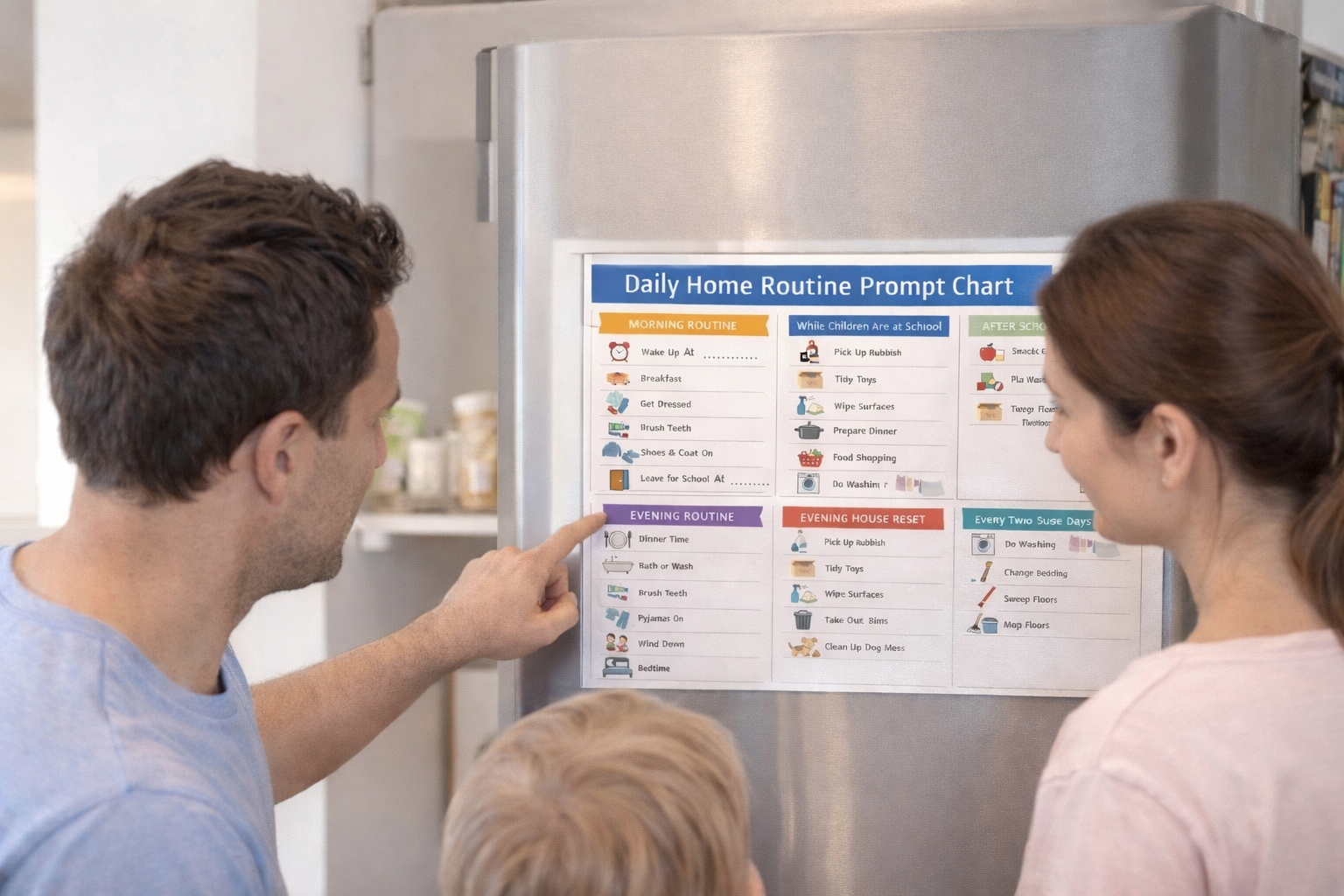
Something as simple as a daily routine prompt chart on the fridge or kitchen wall can act as a gentle reminder throughout the day.
Rather than relying on memory or repeated verbal prompts, the chart quietly supports parents to stay on track.
A Practical Tool for Families
The Daily Home Routine Prompt Chart was designed with these principles in mind.
It breaks the day into simple sections including mornings, after school, evening routines and small household resets. The aim is not to create pressure or unrealistic expectations, but to provide a clear and supportive structure that families can adapt to their own routines.
For some parents, having tasks displayed visually can make it easier to take initiative, share responsibilities, and maintain a calmer household rhythm.
When parents feel more confident and organised, children are more likely to experience consistent care and support.
Sometimes the smallest tools can create the biggest shift.